What is this game?
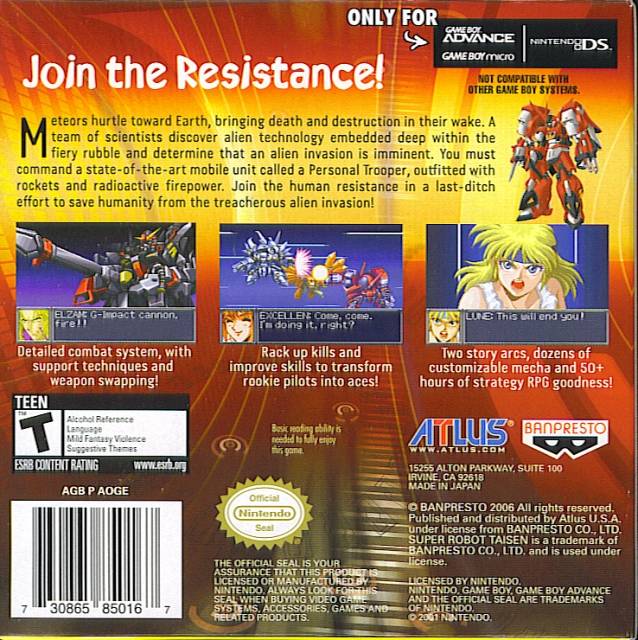
Super Robot Taisen: Original Generation is a Tactical RPG developed by Banpresto for the Game Boy Advance, released in November of 2002 in Japan, and August of 2006 in North America.
Super Robot Taisen (Super Robot Wars in Japan) is known for gathering several anime mecha shows like Mobile Suit Gundam, Getter Robo, and Mazinger Z into a single game. Due to the amount of licensed properties that usually appear in this series, none of the games created before this one saw an overseas release. However, due to the fact that this game contains only characters and robots created by Banpresto (hence the tagline ‘Original Generation’), this game had far fewer hurdles barring it from a release outside of Japan.

Story
The game takes place in an era called New A.D., in a world where mankind has built colonies out in space and on the moon and where Personal Troopers, giant-scale humanoid robots, have been constructed with strange technology found inside a gigantic meteor.
The story follows one of two protagonists chosen by the player, Ryusei Date, a hot-blooded mecha otaku, and Kyosuke Nanbu, a straight-shooting army Lieutenant, who join a team of Personal Trooper pilots in the Earth Federation Army. They and their comrades face the dual threat of Bian Zoldark and the Divine Crusaders, who have launched a campaign to conquer the world, and the mysterious extraterrestrial beings known as the Aerogaters whose true intentions remain unknown.
The overarching story borrows mainly from Super Robot Wars 2 for the first half of the game, and Shin Super Robot Wars/Super Robot Wars Alpha for the second half. The characters from those games plus Super Robot Wars 3, 4 and Impact make up the cast, in addition to several characters that debut in this game.
I’ll be brief with my opinion so as to avoid spoilers. Being the first game of a series, the story doesn’t get overly-complicated, since it also needs to establish what the world is and who’s inhabiting it. It’s not bad, just not very ambitious compared to later entries. The playable characters on the other hand make a pretty strong first impression. They mesh well with one another and stand out in their own way. Definitely the highlight of the lore in this game.

Gameplay
The gameplay of Super Robot Wars is very similar to other Tactical RPGs. In comparison to Fire Emblem, there is no permadeath, though you are docked a repair fee for any destroyed units, and you have the option to create a quicksave point at any time during the Player Phase. And if you do get a game over, you can restart the stage while retaining all the money, EXP and Pilot Points that you had acquired in your previous run.
However, in addition to Victory and Defeat conditions, you also have a Battle Mastery condition. These are optional goals added on to the Victory condition, such as clearing the map in X number of turns, or destroying an enemy that retreats when it reaches 30% HP. How many Masteries you earn affects the difficulty level, and whether or not you can earn certain secrets or stages.
A feature that makes its debut in Original Generation is the ability to equip some of your mechs with extra weapons. Each mech has a certain amount of Weapon Space, and you’re allowed to equip as many weapons as you want to a unit as long as you don’t exceed the unit’s max W Space. However, some units (like battleships) have very little or no W Space at all, but make up for it by having extremely powerful attacks or innate versatility.
Overall, I would say that Super Robot Taisen is easier on the surface than Fire Emblem, but more difficult if you want to go for the Battle Masteries. The quicksave feature is neatly integrated into the experience, especially when it comes to defeating enemies that retreat when they lose enough HP. And the equipable weapons are, in my opinion, an essential layer to this game. Being able to create a personalized loadout or cover the weaknesses for certain mechs meshes perfectly with the ability to learn Pilot Skills and transfer pilots to different mechs, while making more one-trick mechs shine more brightly for their strengths.

Visuals
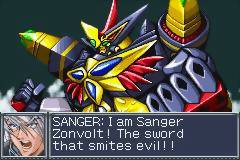
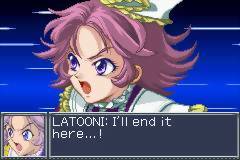
The graphics are fairly simplistic, which isn’t surprising considering this game is for the GBA. Although the mechs are no longer still images with special effects added in like in SRW A and R, they don’t possess the fluidity of later entries with the exception of ultimate attacks. I do like the close-up pixel art of the various units that flash on-screen when they use their strongest attacks, but I also think that the collection of mugshots used in character dialogue are lacking in variety, especially for Ryoto, Excellen and Bullet.
Music
Like the characters, the music is also pulled directly from other SRW games, in addition to several new themes created for this game. The majority of the battle themes really get you into the action, and I personally could listen to them for quite a while without getting tired of them. If there is a weakness to the soundtrack, its that several characters are stuck with the default BGM “Born to Fight,” a very good piece in its own right, but about half of the playable cast are assigned it, and you can’t change the BGM in this game.
Did I enjoy the game?
Yes, I did.
While the game is noticeably more dated than its sequel, as someone who had only played the Fire Emblem series beforehand, I really enjoyed playing Original Generation. The lack of permadeath and ability to quicksave did not cheapen my experience, and while many of the Battle Masteries added more complexity to the stages, none of them made the game outright unfair.

Would I recommend this game to others?
Yes, especially if it’s their first SRW game.
The Super Robot Wars series isn’t for everyone, especially since many of the games are only in Japanese and only three have been officially released overseas. But for people who have been interested in Tactical RPGs but have felt that Fire Emblem has too many moving parts, or for those who have been looking for an entirely new variation of the genre, Super Robot Taisen: Original Generation is a very good introduction to the Super Robot Wars series as a whole, and I’d definitely recommend trying it. Who knows, maybe you’ll like it enough to import the other games in the series. That’s what happened with me.