WARNING! This review contains story spoilers for:
– This game
-Masoukishin I
Read at your own risk.
Also, here’s a link to my previous review if you missed it. Reading it beforehand isn’t necessary, but will aid in understanding some of the changes made from that game to this one.
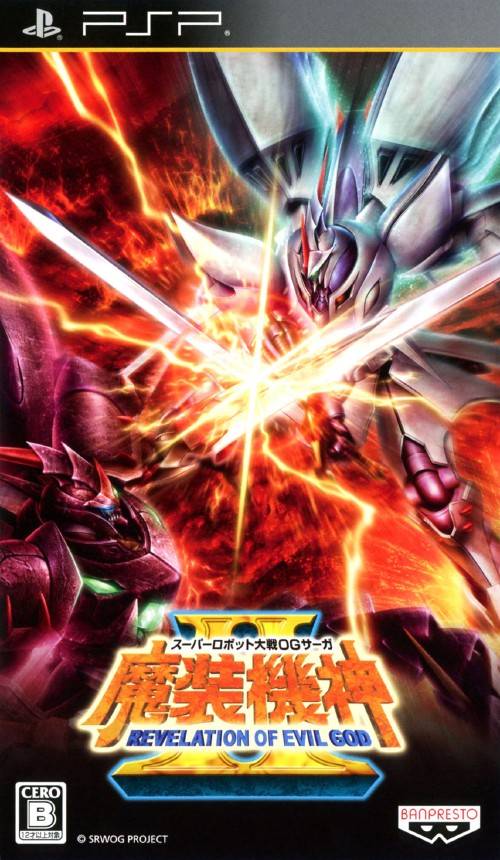
What is this game?
Super Robot Wars OG Saga: Masoukishin II – Revelation of Evil God is a tactical RPG for the PSP that was released in Japan back in January of 2012. It is a sequel to the PSP game SRW OG Saga: Masoukishin I – The Lord of Elemental. It was released both as a standalone title and in a combined package with the aforementioned prequel.
In my review of the previous title, I said that I enjoyed the SNES version in spite of the many dated designs. I also said that in spite of needing to stick to many of those designs, I enjoyed the PSP remake even more.
However, with an entirely new entry in the sub-series, we have a chance to see the unique gameplay elements shown in Masoukishin I further refined and built upon. Did the developers succeed in that, or do we just have a clone of the last game? Let’s dive in and see.
Story
A brief summary of the endings of the last game
Due to the nature of the previous game’s multiple endings, I will provide a brief summary detailing certain events that might otherwise be exclusive to specific endings. Feel free to skip this section if you have not played/are not interested in the story of Masoukishin I.
Note that this section assumes that the reader has a general knowledge of the previous game’s story. Also, I’m only covering plot points for Part 2 of that game, since Part 1 doesn’t have multiple endings.
SPOLIERS FOR THE PREVIOUS GAME WITHIN!
The following characters have died:
- Glave Zolushard, President of the Shutedonias Alliance
- Rasetz Novaste, leader of the Shutedonias military and one of the main instigators of the Four Seasons War
- Kanswort Jog, right-hand man to Rasetz
- Ludvicca Häkkinen, a mercenary responsible for killing both Tytti’s family and Ricardo Silvera, the former herald of Zamzeed
- Zetz Laas Bragio, insane alchemist who developed many of the machines used by the Republic of Bagonian
- Tudy Lasm Inkart, Wendy’s twin sister who died as an infant, but her spirit tried to possess Wendy in order to destroy the world
- Thomas Bright, former DC Soldier turned Bagonian Mercenary
- Shumel Hule, the Sword Saint of La Gias and teacher of Rosalie
The following characters have survived and have joined or re-joined the Masoukishin Corps:
- Former members Simone, Becky, Fang, Demeksa, Tian and Ahmad have all survived and re-joined.
- Rodney and Ellis have left the Shutedonias army to join the Corps
- Gino has left the Bagonian army to join the Corps
- Rosalie has also joined
- Wendy has survived and is no longer possessed by her twin sister Tudy
Summary of this game’s plot
In the wake of the Four Seasons War, the Masoukishin Corps had stopped Shutedonias from starting another war, dealt with a hostile faction of the Republic of Bagonia, and prevented another attempt by the Volkruss Cult to revive the object of their fanaticism.
Since then, the Masoukishin Corps has been reorganized into the Antiras Squad, now acting under the authority of the Federation (La Gias’ equivalent of the U.N.). While the loss of direct support from Langran means they have to provide their own income, they now have greater authority to act in the other countries of La Gias.
Yet they have no time to gradually adjust to this new status quo. Even with the death of one of their archbishops, the Volkruss Cult still remains a very active threat. They now seek to release Rasphitot, the god of Balance in the mythology of La Gias, believing that this will aid in their greater ambition of Volkruss’ revival.
Not only that, but after the death of their leader, the Shutedonias Alliance has broken out into a civil war, and multiple terrorist organizations have begun launching attacks all over La Gias. And amidst all this chaos, repeated confrontations against people seeking revenge for the deaths of those killed in the previous conflict and a mysterious mech resembling his own machine has Masaki questioning his place as Cybuster’s herald…
Story Flow and Continuity
In contrast to the previous game having so many possible branches to the story that it gave a “choose your own adventure” feel to the plot, this game goes for a much simpler structure. Based on a couple of decisions you make in the first few stages of the game, you’ll proceed through one of three story branches. Each branch shares the same plot (for the most part) for the first two-thirds of the game, after which they tell their own version of the events that lead up to the end.
One final point to cover is how the plot of this game ties into the sequels. While the continuity issues from multiple endings is still present, it is considerably lessened. All characters that live to the next game survive regardless of which route you play on. The same thing goes for characters who die. The only difference between routes is the circumstances surrounding their deaths.
So while there’s once again no true “canon” route and story elements from all three are present in the next game, it’s to a far lesser degree than in the previous game.
Opinion (Subject to be updated as I am not knowledgeable about every detail of the story)
As for the actual plot, it’s kind of hit-and-miss. The various conflicts that I mentioned in the summary are pretty much self-contained. There’s some overlap here and there, but mostly the Antiras Squad is dealing with a single conflict for a few stages (sometimes only one) before moving on to deal with another.
And then there’s some stages where they don’t deal with any of those conflicts, but instead just take a side-job that happens to bring them into a battle. Heck, one stage has half of your pilots unavailable because they’re trying to unload an excess of merchandise from their store, the Antiras Shop.
The overall plotline is reflective of the heroes being a psuedo-mercenary force, taking what jobs come their way while fulfilling their oath to protect the world at large. And there are plenty of times where this does work. It sets a more “slice-of-life” tone than is present in mainline OG plots.
The double-edged nature of this comes in when that novelty wears off. When it does, I felt like the story had stopped dead for the purpose of injecting a humorous situation, and I just wanted to get back to the more serious story elements.
All that being said, I do like the greater plot presented throughout the entire game. And I also enjoyed many of the shorter, self-contained stories. I’m just think that the way the latter are ‘seeded’ throughout the former interferes with the pacing.
Gameplay
This game retains the same gameplay changes made to the traditional SRW formula that were introduced in the previous title, including Direction, Height, Element and Prana. Certain systems have, however, seen some adjustments. The two ones that I want to highlight are Terrain Bonuses and Pilot Skills.
Terrain Bonuses
In other SRW games, certain types of terrain would give bonuses to Defense and Evasion. This was absent in the first Masoukishin game, most likely due to the addition of Height and Direction. This time around, terrain bonuses are back, and they can also effect Accuracy in addition to the two other stats.
However, things work a little differently this time around. Whereas other games would offer the same kind of bonuses no matter what unit occupied it, this time the bonuses differ depending on which of the five elements the unit in question is aligned with. For example, water grants Water-type units bonuses to the aforementioned stats, but all other units actually suffer penalties to those stats.
I find this to be a great addition to the Masoukishin formula. It reintroduces a gameplay element from the other SRW games in a way that also slips in an element of Terrain Ranks. It doesn’t overcomplicate stages, but it gives you one more thing to consider when choosing where to station your units, and now not every stage has to have a huge range of elevations in order to be interesting.
Pilot Skills
The more impactful change in gameplay, in my opinion, is the Pilot Skills. In Masoukishin I, each pilot’s skills were preset, and they were learned and/or strengthened as you leveled up. This was one of the main causes of imbalance among the cast, as some characters would learn all six skills in that game, while others would only learn three.
In this game, each pilot earns to a maximum of 5 skill slots as they level up. Most skills are learned by all pilots when you clear specific stages, with a few character-exclusive skills needing specific conditions cleared to unlock. Each skill costs between one and five slots to equip, with the more powerful skills generally requiring more, and you can freely switch between skills at any time.
This new way in which pilot skills are handled is a vastly superior, and it makes the roster of playable pilots is far more balanced. Add in the fact that you can now choose what your pilots will learn as their sixth Spirit Command, and you have far more options for customization than the previous entry.
All that being said, the new system isn’t perfect. While you can equip up to five skills in theory, most of the skills need two or more empty slots to equip. This means that not only do you usually end up with two or three skills at most, but you also are limited in the combination of skills you can use.
And then there’s the way these skills get stronger. While some are at a fixed level, most of them gain one “experience point” every time that character attacks or is attacked while they have that skill equipped. However, the number of enemy and ally units that deploy on each stage is far less than in other SRW games, AND many of these skills require 20 to 50 battles before they can increase in level.
With these two limitations in place, what I ended up doing was choosing a small pool of skills I though would be most useful, and then I just stuck with them throughout the game. So in the end, I still prefer way skills are handled in many of the other games, particularly the mainline OG games. Still, while not optimal, I’d say it does things well enough to not get in the way of the overall experience.
Visuals
Since this game was made from the ground up on the PSP, the visuals have been improved over the PSP release of Masoukishin I.
The areas where this shines the most are the maps and the map sprites for units. The scale for these has been magnified without sacrificing map size. Besides allowing for greater detail in the sprites, it also means more depth in the color palette, so units no longer have those white highlights that are supposed to represent light reflections. And any effects such as running water or flickering flames have improved animations in addition to improved color and detail.
The battle animations have also seen an upgrade. The special effects for attacks are much more dynamic (especially the lighting on the unit’s armor), and the models for the units are much cleaner. In addition, the animations for the signature attacks of many of the units are much more fluid. Sure, not every unit gets that treatment, and the basic attacks still feel like they skipped out on animation frames. But the attacks that do get that special treatment are now on par with what you’d see in the main OG series.
One final note is that in the last game, all of the cutscenes either took place on the world map or on a stage map. Now, most of them have proper backgrounds to represent the locale, like ship interiors, city streets, et cetera.
Other than that, things like character portraits and special images pretty much keep the same quality as the last time, though in my opinion this is more because they didn’t really need any improving upon.
Music
Let’s get the disappointing stuff out of the way first. Most of the returning playable cast either retain their personal theme or are still stuck with the generic theme, Endless Battle. And most of the new ally pilots, instead of getting their own themes, are also assigned Endless Battle as their default BGM.
Don’t get me wrong, I do like Endless Battle. I’m just somewhat confused and slightly disappointed that with the large cast at their disposal the developers didn’t create new music tracks to go along with them. Then again, I did play Masoukishin III before this game, so my opinion may be slightly biased. Take it for what you will.
Now, that’s not to say that ALL of the music is recycled. We do have a few new themes for the heroes. Namely, Princess of Passion for Xenia, Blade of Vengeance for Gaen, and Possession, the theme for when Masaki activates Cybuster’s special ability. And while that may be all there is, all three themes are
And on the enemy’s side, we have even more new music. There’s Black Sword Saint for Cybuster’s mysterious doppelgänger, Zelvoid, Decisive Battle for the self-proclaimed god of Balance, Rusamuno Rasphitot, and Time of Parting, the theme for the final boss of all three routes.
So, to summarize, all of the returning music is still great, and all of the new music is just as good. My only complaint is that there’s surprisingly few new tracks for the heroes, though this does get addressed in the next game.
Did I enjoy the game?
Yes, I did.
Masoukishin II did indeed take the unique aspect introduced to the SRW formula by the previous game and build upon them. Sure, not everything lands as the developers intended, but the things they got right far outweigh the things they got wrong. I really enjoyed my initial playthrough, and even the subsequent playthroughs I did to experience the different story paths.
Would I recommend this game to others?
Yes, especially if you enjoyed the previous entry, or if you’re a fan of Final Fantasy Tactics/Tactics Ogre-styled SRPGs.
If you tried the previous entry and decided that the systems were just too dated, I’d suggest giving this one a try. Everything’s been polished up and refined, and while it hasn’t attained perfection, it’s a great improvement in just about every category. Plus, the PSP is region free, so although you’ll still have to deal with the other hurdles that come with a Japan-exclusive game, you won’t have to deal with that one.