WARNING! This review contains story spoilers for the game in question. Read at your own risk.
What is this game?
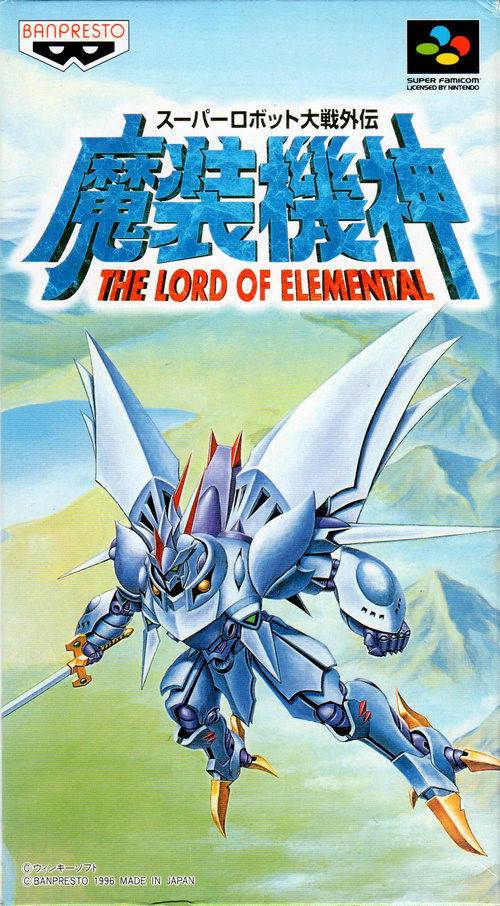
Super Robot Wars Gaiden: The Lord of Elemental is a tactical RPG for the SNES/Super Famicom that was released in Japan in March of 1996. It is the first game to feature only characters and mechs that were created by Banpresto for the SRW series. It also acts as a prequel story for protagonist Masaki Andoh, pilot of the Cybuster.
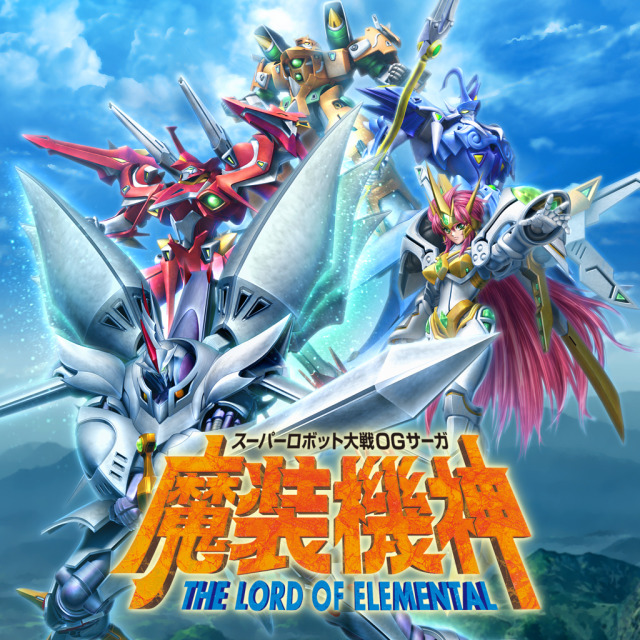
An updated version of this game, titled Super Robot Wars OG Saga: Masoukishin – The Lord of Elemental, would be released for the DS in May of 2010. This version would be further updated and re-released for the PSP in January of 2012, alongside it’s sequel, Masoukishin II – Revelation of Evil God.
In this review, I’ll be looking at the various elements of the game as a whole, and then elaborating on the differences between the SNES and DS/PSP versions. For those curious, the major differences between the DS and PSP versions (that I’m aware of) are as follows. Otherwise the PSP version is a direct port of the DS version.
(Also note that I’m basing this on the PSP version, so I apologize if I make erronious statements about the DS version.)
Version Differences – DS VS PSP
- In general for the PSP version:
- The quality of the music and graphics have been enhanced, though not to the same level found in Masoukishin II.
- Voice acting was added for all in-battle scenes.
- All stages in Part 1 (see Story for details) now have the Nors and the Wizol instead of the Nors Rei and Wizol Kai.
- In the DS version, you could access the music player, image gallery, scenario chart, and glossary from the Title Screen.
- In the PSP version, you need to access it from a save file, which means you will need to play the game multiple times in order to complete the aforementioned sections.

Story
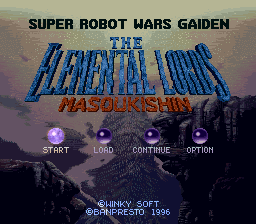
The story of this game is divided into two parts, with a timeskip in the middle representing the events of multiple games.
SNES
Summary
Part 1 of the story takes place before Super Robot Wars 2, and details the origins of the first original character created for the Super Robot Wars series, Masaki Andoh. Here we see how he first came to the pseudo-subterranean world of La Gias, how he came to be the pilot of the legendary Wind Masoukishin Cybuster, and how his complex rivalry with Shu Shirakawa began. It also covers more of the backstory of the other Masoukishin pilots, Yang Long and Tytti, and the original pilot of the Earth Masoukishin Zamzeed, Ricardo Silvera.
The interim between parts 1 and 2 are the events of SRW 2, 3, EX, and 4/F/F Final. Part 2 takes place after F Final. The Masoukishin corps pulling themselves together in the aftermath of the events of SRW EX. Even though hostilities between the Kingdom of Langran and the Shutedonias Alliance have ‘officially’ ended, certain individuals in both Shutedonias and the Republic of Bagonia are scheming to take advantage of the instability in La Gias for their own ends.
Progression
In a similar manner to SRW games of the time, the story of this game is dictated by the choices you make in battle and during conversations. For example, if Masaki is level one after the first stage, you’re sent to the Training stage. If he’s level two, you can answer “Well… Sure, why not.” or “No can do.” to a post-battle dialogue question to get sent to two other stages.
Now while this may seem like a bit much, (and I don’t know how the people who made the ENG patch managed), I appreciate how the story is integrated with the aforementioned mechanic. There are multiple endings to the game, so replay value is decently high.
The fact that the two halves of this story are presented as a prequel and sequel, respectively, to the other games in the Classic timeline, make it such that the free-form story doesn’t clash with the other entries. Any important story points, like the events that lead to Masaki leaving La Gias to hunt down Shu on the surface during SRW2, are set in stone.
If there’s anything I have against the story, it’s in Part 2. There are a few plot points in the story that are only fully realized if you take certain stage routes. This includes a character that first appears in Part 1 who has backstory with one of the main protagonists and is responsible for the death of a major character. You only get to settle up with him in one of the endings, otherwise he just kind of vanishes off the face of the Earth…or La Gias, in this case. Still, loose threads aside, I think that both the story and the way it’s told are pretty good.
DS/PSP
Summary
Part 1 of the story takes place before Super Robot Wars Original Generation, the interim between parts 1 and 2 are the events of SRW OG, OG2, OG Gaiden, and OG2nd/OG Dark Prison. Part 2 takes place after OG2nd/Dark Prison.
The story is by and large the same. The major differences are found in the connections to the OG timeline rather than the Classic timeline. This is mostly present in the story-only stage Memorial Day, which also has a cameo by Ryusei Date during the Granzon’s attack on Antarctica.
In all honesty, due to the nature of stage progression in this game, most of the changes are lost on me. The only ones I know of for sure are an extended scene after completing In the Depths of Despair, and additional backstory for Shu Shirakawa after Reunion with Shu. So by and large, just figure that the story in and of itself is the same.
Continuity Complications
The endgame, though, is where things get muddled. See, depending on the choices you made, the story ultimately locks into one of three ‘routes’, leading to one of three endings. The events that happen in each ‘route’ are more or less exclusive to each other. Now, since this is the cap-off to the classic timeline, you could say that any of the endings that you reached is the canon one.
However, with there being further story in the OG timeline after Part 2 of this game, well, that’s where we have some problems. As a result, the continuity at the start of the next game is a combination of the events that take place in the aforementioned routes. You just need to pick out which elements are canon and which aren’t. This makes the stories of Masoukishin I and II feel more standalone compared to the mainline OG games.
Okay, all that being said, I acknowledge that Banpresto couldn’t have foreseen that they would remake this game with sequels in mind more than a decade later. The story was written as a finale to the Classic timeline, and they wanted to preserve it as best they could. And yes, it’s not that hard to figure out which parts of the story continue on into the canon, and then just generalize the rest. It bugs me, but it’s not a deal-breaker.
Gameplay
SNES
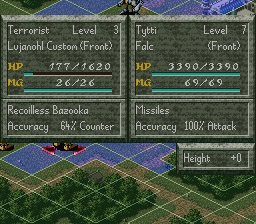
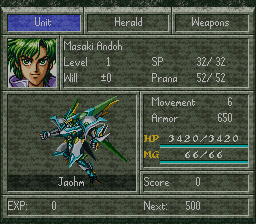
The mainstay gameplay elements from SRW are here: mainly Morale and Spirit Commands. However, there’s no motherships on your team to defend, meaning that losing conditions are tied to much frailer units (usually Masaki). Terrain rankings for units and weapons are also no longer present. And the ‘mobility’ stat for mechs is also gone, meaning evasion is solely reliant on the pilot’s evasion and certain ‘new’ mechanics.
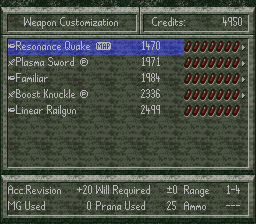
The Lord of Elemental does introduce a few new gameplay mechanics. These include units having Weapon-Triangle attributes, an secondary energy gauge that affects unit stats, the ability to upgrade certain weapons into entirely new weapons and a positioning system akin to Final Fantasy Tactics. These factor in to a unit’s offense, defense, accuracy and evasion. For a more in-depth explanation of these mechanics, I suggest checking out this page.
These mechanics make positioning and resource rationing much more important, as rushing in or spamming your best attacks will leave you vulnerable. To balance this out, the maximum number of units per map for allies and enemies is significantly smaller than most other games. This prevents you from having your weakest unit getting swarmed.
All this being said…not all units are made equal. The four Elemental Lords and the Valsione are significantly stronger than most units, so you’ll usually have them in the lineup. And some units are just not worth bringing along unless you are on a specific route where you gain a secret attack. But in my opinion, the most aggravating part of the game is the pilot skills.
Since this is the second game to have this mechanic, the system is very simple; you gain new skills and better skills by leveling up. One of the skills present in the game automatically turns your unit to face the direction of an attacking enemy. In theory this lessens the damage you take, but if you ended your turn facing a specific direction in order to be better defended against a horde of foes, this could end up exposing your back to them. And no, you can’t disable skills.
The other part of this is the fact that in the endgame, the bosses will have skills that can outright nullifying your attacks. So if you set everything up so that you use your most powerful attack with Strike and Valor applied, it can randomly be canceled, meaning that you wasted your SP, EN and Prana. Combine this with those endgame stages having very few enemies to gain Will on to use powerful attacks, and it can hit that fabled early Nintendo difficulty.
DS/PSP
Purely in terms of mechanics, the port is a 1-to-1 recreation of the SNES version. Positioning, Prana and Elements are all in place. The level at which characters learn certain skills and Spirit Commands are tweaked, but that’s about it.
However, I feel that the game is, on the whole, much easier. For one thing, each time you complete the game, you carry over 1 million credits, along with whatever cash you didn’t spend on upgrades, on to the next playthrough. I also feel that the game is more balanced with regards to the internal calculations, especially the Random Number Generation. Fourteen years is a long time to refine those in-game values, after all.
Now, I don’t have access to the code of the game (nor would I understand it if I did), so this might all be in my imagination. But when I played through the game on the PSP, it just felt that accuracy and evasion rates were more accurate to the numbers shown, and the skills on bosses activated a lot less.


Visuals
SNES
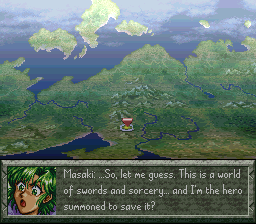
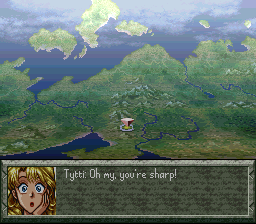
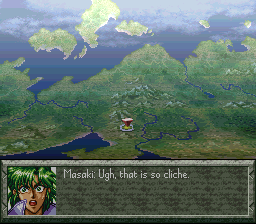
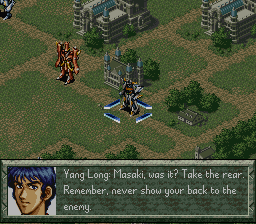
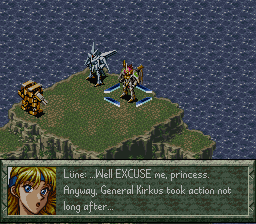
At the time it was released, the graphics for this game were taken way above and beyond anything in the previous entries. The maps are shown from an isometric view instead of a top-down one. The map sprites for units are now full-scaled instead of just headshots, including movement sprites and four different angles to complement the isometric camera. The World Map is also presented as an inverse-globe, a very impressive feat for the time.
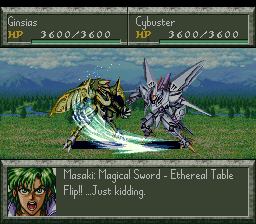
The in-battle sprites, while still not animated, are now full scaled images instead of the Super Deformed sprites that we’ve gotten up until this point. And the character portraits are not only better in terms of quality, but in quantity. Now all the major characters have a full range of expressions for different emotions. And I’ve always felt that this in particular was something that added a whole lot more investment to the dialogue, especially since SRW typically is in Japanese, and almost always lacks voice acting outside of battle.
All in all, this game takes advantage of everything that the SNES graphic chip can give, and it produces an incredibly good-looking game.
DS/PSP
Compared to the SNES version, things are on the whole improved. The map textures are not only much cleaner, but due to the more powerful hardware, certain details are changed. A few stages were presented as grasslands with some scattered buildings and roadways that looked to be made of dirt. Now those stages are presented as fully civilized areas, with brick roadways, many more buildings, and several smaller details such as hedges and pedestrian walkways. Also, things on the map that had animation, such as water, are a lot smoother.
The unit sprites are cleaner too, but they do have a bit of a ‘sheen’ to them, most likely because of compressing things down to a DS screen’s size. They also appear to be slightly downsized. Overall I like them better, but I can see the argument for the SNES sprites.
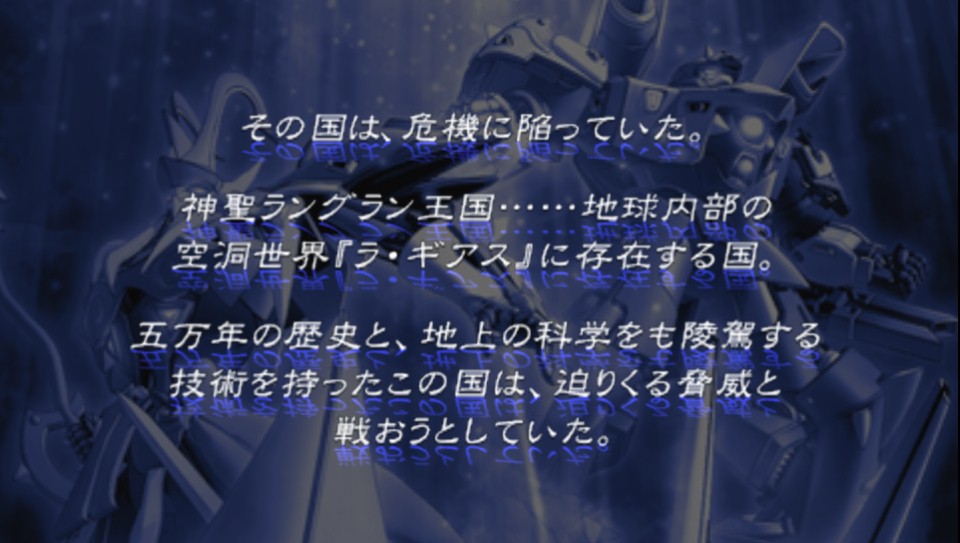
A major addition is that of special images. To better illustrate parts of the story, occasionally the scene will cut away to a still image of what is happening at the current moment. Besides being a treat to look at, these add a lot to helping build a mental picture, and I wish they would do the same thing for the mainline OG games.
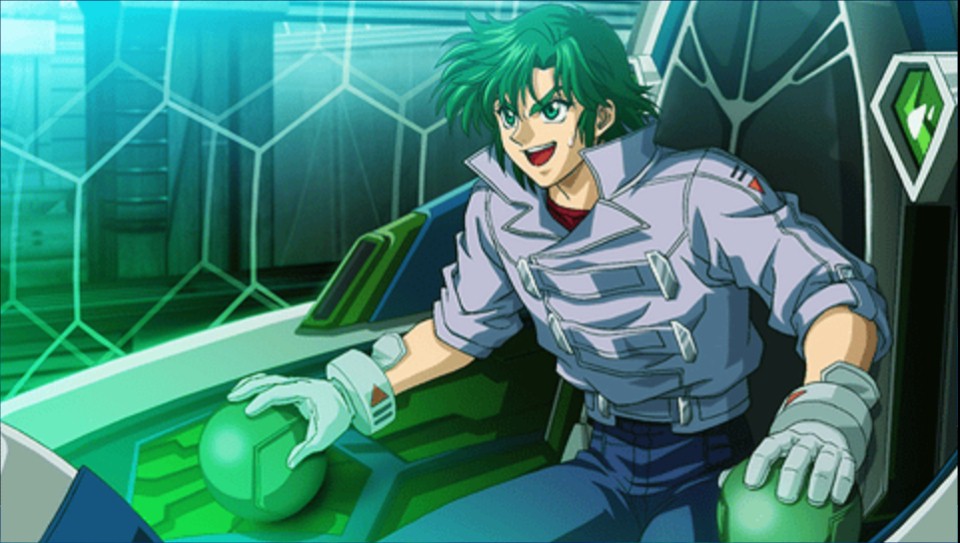
The biggest change is the battle animations. First, the units are scaled to their actual proportions instead of being Super Deformed. The camera is in an Over the Shoulder position to give a ‘showdown at high noon’ feeling between the two combatting mechs. The way that the sprites are designed is immaculate, to the point where they almost look like 3D models. And that’s considering that they do use 3D models for the major character’s most powerful attacks!
However, the trade off for this is a lack of fluidity. The super-smooth animations that had become more or less a mainstay around the release of OG2 and Alpha 3 are now only present in the aforementioned finisher attacks. The mechs now move with a noticeable stiffness when performing most attacks and when recoiling from damage. Still, while I overall prefer the fluidity of the more SD style sprites in the mainline OG games, I like the style this game is going for in its own right.


Music
SNES
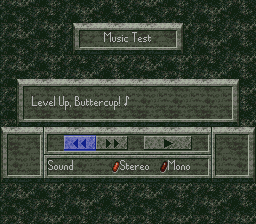
Before talking about the music itself, I want to point out the increased diversity in the music. You have your usual variety of songs, map themes for player and enemy phases, cutscene music, and songs for then battles occur. This time, though, the songs are all original pieces. And for the first time, we have other songs for player units than ‘Reppu! Shippu! Cybuster!”.
This game is where the iconic Dark Prison and Flapper Girl songs for Shu Shirakawa and Lune Zoldak debuted. You also have other great tracks like Fiery Chinese Gym Teacher, From the Land of Lakes and Marshes and Mio’s Traditional Japanese Dance, and Approaching Enemy.
And in addition to a soundtrack fully composed of original pieces, they again stepped up the quality in this department. Again, the technical aspects are above my realm of knowledge, the music in general sounds more fleshed out, even when they were still primarily using MIDIs. And all of the songs are worth hearing in and of themselves, even the ‘generic’ unit theme Endless Battle.
DS/PSP
Honestly, I don’t have that much to say about this. If you listen to the tracks side-by-side, there’s a noticeable difference, but to my ears, not enough to elicit in-depth contrast. The DS’s sound chip is, from what I’ve researched, more powerful than the SNES. The SNES, however, was built to be used with TV speaker, where the DS has it’s smaller, more tinny ones. Throw the PSP’s hardware into the mix, and that’s way to much minutia even for me.

Did I enjoy the game?
SNES
Yeah, I would say I did
All in all, the game’s pretty good. At basic level, it’s to the previous SRW games as FF Tactics is to Fire Emblem. While I prefer the latter style of game structure, I still enjoy playing the former. And I think it still holds up even in the present day, barring the difficulty curve of that time. It’s probably at its best when you know ahead of time what route you’re going to take, as well as the units that are the best on that route.
PSP
Yes, more so than the SNES version
Again, I have no conclusive proof that this version is coded differently than the SNES version. But I just felt that a lot of the more frustrating aspects of the SNES version were ironed out. Especially the final bosses, which remained a challenge without needing to RNG cancel my attacks. Combine this with the audio and visual enhancements, and the only reason I return to the original is so I can follow along with the story.
Would I recommend this game to others?
SNES
Yes, at least to give it a try with the ENG patch.
If you own a desktop or laptop, odds are that it has the specs to run a SNES emulator. And the fine folks at AeonGenesis have made a complete English patch for the SNES original, which means that there’s no language barrier here. I’d say that’s a pretty good deal. You might like it, you might not, but you’ve got nothing to lose by giving it a shot.
DS/PSP
If you liked the SNES version enough, absolutely.
I absolutely suggest that you play the SNES version before trying either of these. That way you’ll be able to form your opinion without spending any money or dealing with a language barrier. If you come away from that version with a positive impression, or you feel that you would have liked the game if you didn’t have to deal with the roughness of that era, then I would recommend tracking down a copy of this version.
Obviously I played it on the PSP, but tracking down that version might be a little difficult. The PSP version of this game was only released as a double-pack with Masoukishin II. So for a hard copy of that game, you only have one choice. The DS version should be about the same experience, just be aware that there are no voices and there are a few more bugs.
On the other hand, if you can track down, you’ll also get the sequel, and that game is even better than the first one. Or if you have access to a Japan PSN account, well, the PSP is a region free system. And if all else fails, there’s always emulation if your machine can handle it. So if you want to get what I consider the definitive version of Masoukishin I and aren’t too picky about how you do it, you have options.

